
Skip to content
  • Home
  • Team
  • Pipeline
  • News
  • Publications
  • Contact

Pipeline

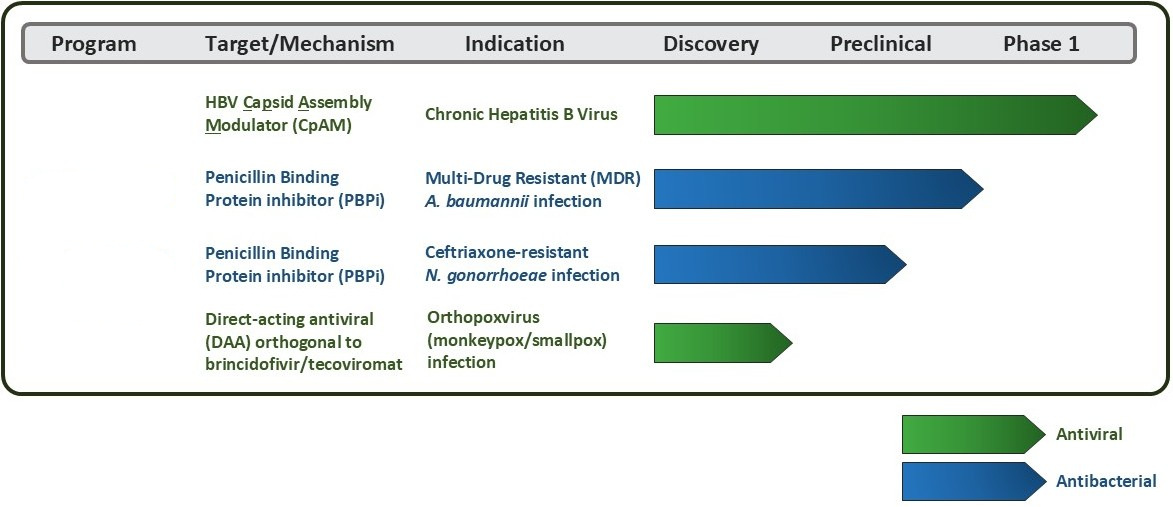
Pipeline Chart

SMP-9945

SMP-14808

SMP-14079

SMP-21583


Hepatitis B Virus Capsid Assembly Modulator (CpAM)

Despite the availability of a safe and effective vaccine, there remains over 257 million people chronically infected with hepatitis B virus (HBV) world-wide. Individuals with chronic HBV infections are at risk for complications due to liver disease and liver cancer. Maximal suppression of hepatitis B virus (HBV) DNA replication should be the primary goal of antiviral therapy. Current front-line therapies (i.e. nucleoside analogs reverse transcription inhibitors) only partly suppress HBV replication, are not curative and require therapy of an indefinite duration in many patients. Novel inhibitors of hepatitis B virus (HBV) are, therefore, required to further suppress viral replication and provide the conditions required to achieve immune control of the infection, termed a “functional cure”. One of the most promising direct acting antiviral strategies in development for HBV are the core protein allosteric modulators (CpAMs). This class of inhibitors bind to the capsid dimer-dimer interface and accelerate nucleocapsid assembly to produce one of two different phenotypes: (1) large aggregated particles that are then degraded by the host proteasome or (2) morphologically normal “empty” particles that are devoid of the polymerase and pre-genomic RNA (pgRNA). Both classes of inhibitors exhibit potent inhibition of HBV DNA in cell culture, animal models of HBV infection and in human clinical trials.

Read More

Using a structure-assisted drug design approach, we incorporated key elements of the known prototypical capsid modulators into a new chemical series and refined the potency, oral bioavailability and safety of the compounds via iterative rounds of medicinal chemistry.  SMP-9945 (formerly VNRX-9945) exhibited potent (i.e., single digit nanomolar), pan-genotypic antiviral activity against HBV both in vitro and in animal models of HBV infection. Combination and cross-resistance studies supported regimens that include both SMP-9945 and a nucleoside analog reverse transcription inhibitor. SMP-9945 exhibited high oral bioavailability and repeated doses for up to 28-days were well tolerated across multiple animal species in preclinical testing. Based on its preclinical profile, SMP-9945 was advanced into human testing and successfully completed single ascending dose studies in health volunteers. Sustained plasma concentrations consistent with potent in vivo antiviral activity were observed following a single oral dose of SMP-9945. Moreover, SMP-9945 was found to be generally safe and well tolerated in human testing. Next steps include completing the multiple ascending dose study in healthy volunteers with the goal of advancing SMP-9945 into phase 1b proof-of-concept testing in chronically infected HBV individuals.

Read Less

Penicillin Binding Protein (PBP) Inhibitor Program

Spring Mill Pharma is developing a novel class of non-beta-lactam molecules that kill bacteria by the same selective mechanism as beta-lactams — blocking cell wall synthesis via binding to the bacterial penicillin binding proteins (PBPs). Chemically distinct from the beta-lactams, these new molecules have been designed to be impervious to degradation by any beta-lactamases. By circumventing over seventy years of beta-lactamase-driven resistance, this new class of PBP inhibitors has the potential to usher in a new wave of antibacterial therapeutics.


Novel Inhibitors of PBP targeting WHO Critical Pathogens

Spring Mill Pharma will continue to advance a proprietary series of Penicillin Binding Protein (PBP) Inhibitors targeting multi-drug resistant (MDR) Acinetobacter baumannii through Phase 1 clinical testing. A. baumannii is ranked as a “Priority 1: Critical” carbapenem resistant pathogen on the World Health Organization’s list of bacteria for which new antibiotics are urgently needed. A. baumannii is primarily associated with hospital-acquired infections and has become resistant to a large number of antibiotics, including carbapenems and third generation cephalosporins – the best-known available antibiotics for treating MDR bacteria.

Read More

We are also focused on discovery, optimization and development of novel small molecule inhibitors of the Penicillin Binding Proteins in other clinically relevant Gram-negative bacteria focused on agents active against carbapenem-resistant Enterobacterales (CRE) and carbapenem-resistant Pseudomonas aeruginosa (CRPA). Enterobacterales and P. aeruginosa rank among the “Priority 1: Critical” antibiotic resistant pathogens on the World Health Organization’s list of bacteria for which new antibiotics are urgently needed. Multidrug resistant pathogens pose a particular threat in hospital intensive care units and nursing homes, as well as among patients whose care requires devices such as ventilators and catheters. These bacteria have become resistant to a large number of antibiotics, including carbapenems and third generation cephalosporins.

Read Less

Antibiotics for Multi-Drug-Resistant Gonorrhea

Spring Mill Pharma has in its portfolio a penicillin-binding protein inhibitor (PBPi; SMP-14079; formerly VNRX-14079) to address the growing problem of resistance by Neisseria gonorrhoeae to ceftriaxone, the last resort cephalosporin-class beta-lactam for outpatient use. The Spring Mill Pharma discovery team has identified and optimized a series of non-beta-lactam transpeptidase inhibitors that are rapidly bactericidal, impervious to beta-lactamases, and show promising selective activity against gonococci, including both wild-type strains and isolates with PBP variants that confer ceftriaxone resistance. SMP-14079 therefore has the potential to maintain PBP inhibition as a core mechanism of action for future anti-gonococcal therapy.


Small Molecule Antiviral Inhibitors of Orthopox Viruses

Smallpox was one of the worst and most prolific diseases in human history, resulting in millions of deaths world-wide until it was finally eradicated in 1980 following a decades-long global vaccination campaign. Although smallpox was effectively eliminated, there exists a significant concern that a new outbreak could occur by accident or due to a deliberate act of malfeasance. The re-emergence of smallpox in the modern era would have even more devastating consequences to global health and security for many reasons: 1) the cessation of vaccination programs following eradication has rendered much of the world’s population immunologically naïve to orthopoxviruses; 2) vaccination is contraindicated in up to 25% of the population due to a multitude of immunodeficient conditions; 3) globalization has greatly increased the risk and rate of viral spread, and 4) hesitancy towards national vaccination campaigns may undermine the rapid response that would be required to contain a new smallpox outbreak.

Read More

The potential for intentional or unintentional release of variola virus, the causative agent of smallpox, remains a significant bio-security threat. The rapid spread of monkeypox clade IIb virus from endemic countries during the 2022 outbreak and a second outbreak of a more transmissible and pathogenic form of monkeypox virus (clade I) demonstrates the impact of inadequately protecting vulnerable populations with effective vaccines and therapeutics. There are currently only two approved antiviral therapeutics for the treatment of smallpox disease, and neither are approved for monkeypox virus infections. Without continued drug discovery efforts, the potential for drug resistance and significant off-target toxicities leaves the public poorly prepared to face bioterrorism and re-emerging threats from orthopoxviruses. To that end, the Spring Mill Pharma discovery team identified a lead series of potent and orthopox-selective direct-acting antiviral inhibitors of ectromelia virus (ECTV, a mousepox virus) exhibiting a novel mode of action (distinct from brincidofovir and tecovirimat) from a phenotypic high throughput screen utilizing a proprietary small-molecule library of nearly 300,000 compounds. Further optimization is underway to optimize physicochemical properties and oral exposure to advance a first-in-class orthopox virus small molecule inhibitor with a unique mechanism of action, high genetic barrier to resistance (by contrast to tecovirimat) for public health and procurement into the national stockpile for biodefense purposes.

Read Less

Copyright © 2026 Spring Mill Pharma, Inc.

  • FCOI Policy
  • Terms & Conditions